

A research-backed guide for soccer players who want to sustain power throughout their 90 minutes on the field—and dominate the second half.
Soccer players need more than motivation to maintain peak performance throughout a match.
Most pro soccer players run 8 to 12 kilometers in a game. An athlete’s fast acceleration in sprints requires high levels of force; they make jumps and fast changes of sprint direction over 250 times in a match. And somewhere in that second half, your legs feel heavy-here’s how creatine increases your muscle mass, improves muscle strength, and athletic performance in the 90th minute.
Every drop-off in soccer performance and slow reaction time isn’t a fitness problem. It’s a mid-game meltdown, and performance drops fast.
During your preparatory phase of intense year-round training, season after season—especially during explosive soccer drills to beat a defender you require relative or active high-energy tasks for a 50/50 ball; your working skeletal muscles build up muscle acidification and deplete their high-energy phosphocreatine stores in 8 to 15 seconds.
On the other hand, once PCr (Phosphocreatine) concentration levels fall, it negatively impacts your muscle contraction, inhibiting your body’s ability to sustain high-intensity power output; as a result, your muscle becomes fatigued and has lower contraction force. The sprint maintains explosive speed late in the 20th minute, but now costs you a step in the 70th minute due to diminishing neuromuscular efficiency.
Micronized creatine monohydrate powder plays a key role in rapidly increasing ATP resynthesis in working muscle cells .
The process unfolds as follows:
- 8–12 kilometers – Distance covered per match
- 250 – Max high-intensity actions per game
- 70% – Of studies show performance gains
- 20–40% – Increase in muscle PCr stores
How Micronized Creatine Monohydrate Powder Responds Well for Soccer Players?
The Phosphocreatine System Explained
Approximately 95% of your body’s creatine (free creatine and phosphocreatine) is contained within skeletal muscle. Therefore, it is quite helpful for faster regeneration of ATP during short, high-intensity bouts.
When you perform high-intensity exercise like a heavy deadlift or a 100-meter sprint, your muscles rely on the phosphagen system (readily available resynthesizing ATP quickly). This system is the fastest way the body produces energy, but it has a very limited “fuel tank.”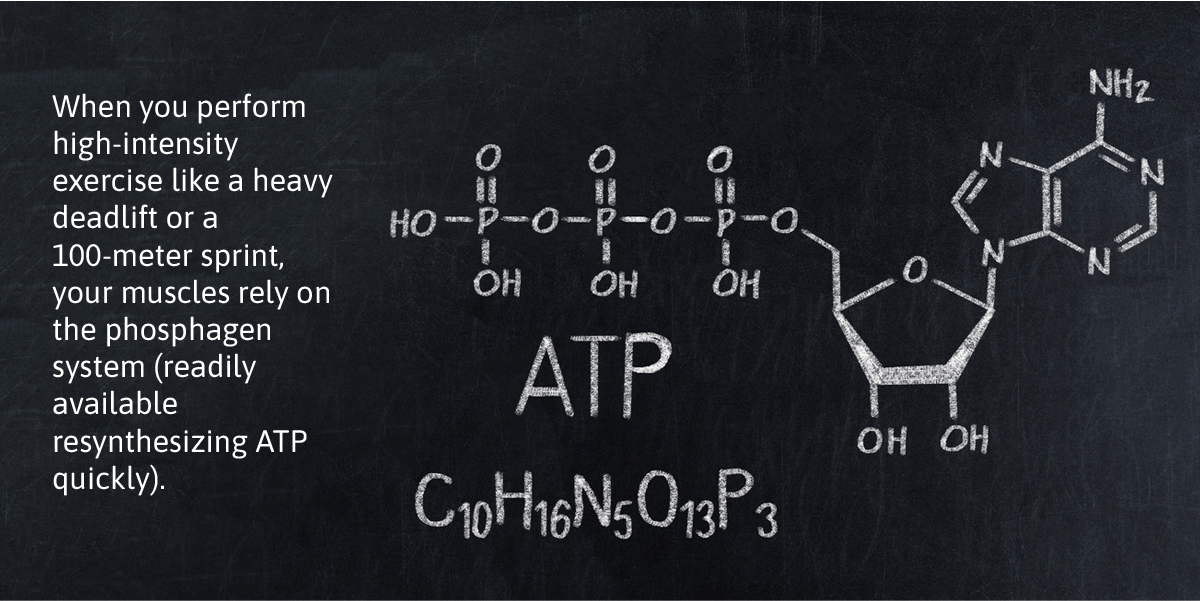
The ATP-ADP Cycle!
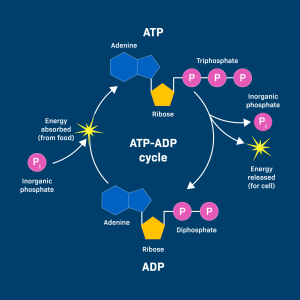
ATP (Adenosine Triphosphate) is referred to as the “immediate source of energy” reserve within muscle cells and fuels various cell functions. To release energy, the body breaks off one of the three phosphate groups, turning ATP into ADP (Adenosine Diphosphate).
ATP + H2O → ADP + Pi + free energy
Your muscles only reserve trace amounts of “ready-to-use” ATP for about 2 to 3 seconds of high-intensity movement. To keep going for a 10-second set of heavy triples, your body must “recharge” that ADP back into ATP instantly.
The Role of Creatine During Anaerobic Exercise To Increase ATP Synthesis and Act As “Body’s Primary Energy Source”!
This is where the Creatine Phosphate (PCr) stored in your muscles comes in. It carries a high-energy phosphate molecule that it can donate to ADP to recreate ATP almost instantaneously.
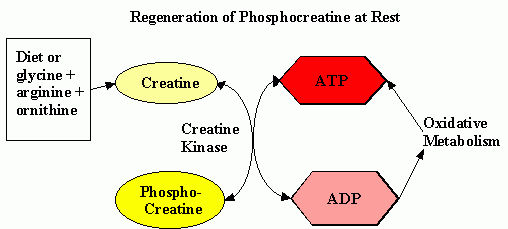
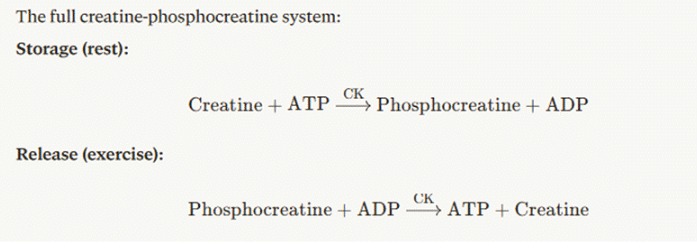
The equation you shared is the creatine kinase (CK) reaction, which rapidly regenerates ATP during intense muscle contraction:
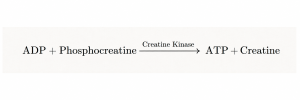
What this means:
→
ADP (adenosine diphosphate) = spent ATP that needs to be recharged→
Phosphocreatine (PCr) = high-energy phosphate reserve stored in muscle→
Creatine Kinase (CK) = enzyme catalyzing the reaction→
ATP = regenerated energy currency for muscle contraction→ Creatine = phosphocreatine after donating its phosphate
By using the loading strategies mentioned in our previous table (which can increase muscle creatine content by 33–36%), you are essentially increasing the size of this backup battery.
Therefore, PCr donates a phosphate group to adenosine diphosphate (ADP) to rebuild ATP within one to two seconds.
What this means:
→ ADP (adenosine diphosphate) = spent ATP that needs to be recharged
→ Phosphocreatine (PCr) = high-energy phosphate reserve stored in muscle
→ Creatine Kinase (CK) = enzyme catalyzing the reaction
→ ATP = regenerated energy currency for muscle contraction
→ Creatine = phosphocreatine after donating its phosphate[en.wikipedia]
Key functions:
→ Anaerobic ATP buffer: PCr anaerobically donates phosphate to ADP to reform ATP during the first 5–8 seconds of maximal effort[en.wikipedia]
→ Rapid energy mobilization: Provides immediate ATP when energy demand outstrips mitochondrial production[pmc.ncbi.nlm.nih]
→ Prevents ADP accumulation: Counters large increases in ADP that could inhibit ATPase systems[pubmed.ncbi.nlm.nih]
→ Reversible reaction: Excess ATP converts creatine back to phosphocreatine during rest[youtube][en.wikipedia]
The full creatine-phosphocreatine system:
Why Short-Term “Creatine Loading” Is Most Effective for Explosive Movements?
In this context, muscle creatine levels can increase by ~35%. For explosive movements, that extra 35% storage means:
- Extended Peak Power: You might maintain maximum force for 8 seconds instead of 5.
- Faster Recovery Between Sets: As shown in the plasma tables, maintaining high levels of creatine allows the muscles to resaturate their stores faster during your rest periods.
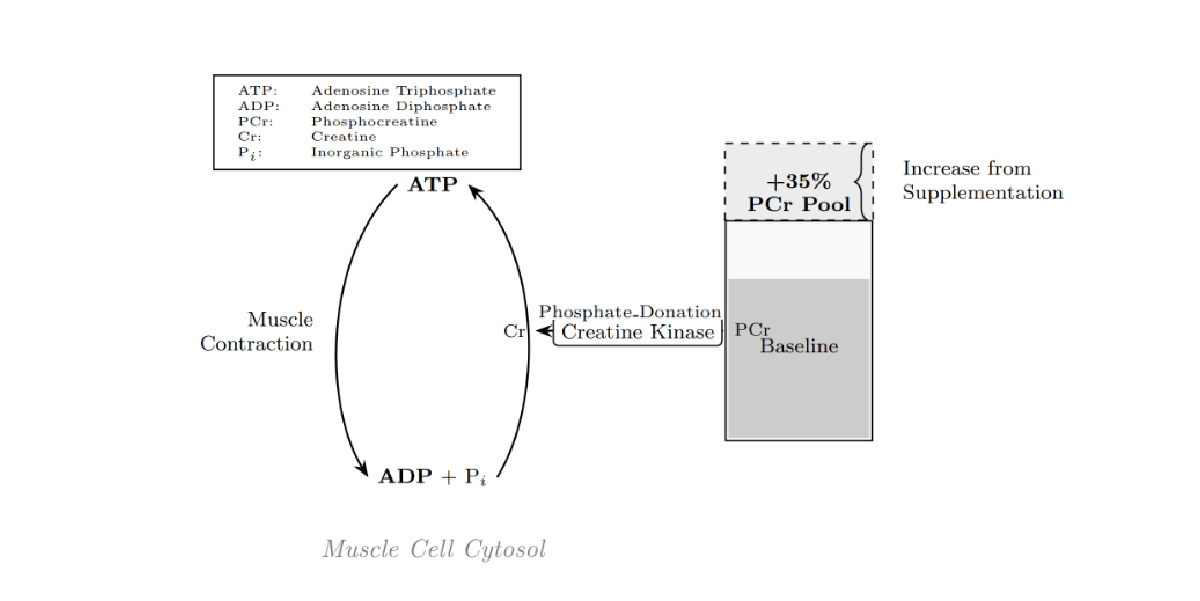
The resynthesis speed is likely sufficient for how quickly your muscles restore ATP and glycogen, and keeps you fully restored for the next bout.
The elicited ergogenic benefits of creatine supplementation increase your intramuscular reserves of PCr stores (of total creatine and phosphocreatine) by around 20 to 40%. That buffer means faster ATP regeneration and more explosive power across repeated efforts.
Key insight: Creatine doesn’t boost your aerobic training adaptations—it supercharges your phosphagen system. Anaerobic performance improves significantly (effect size SMD = 1.23, p < 0.001). Intensity of aerobic endurance within a concurrent exercise regimen is largely unaffected. For soccer sports, that’s exactly the adaptation you need.
Why Creatine Monohydrate supplementation wins compared to other forms?
Creatine monohydrate (CM) is the most studied supplement in sports science. Dozens of gold-standard experiments and randomized controlled trials confirm how well CM works and how safe it is to use, among them …
→ CM increases muscle creatine and PCr concentrations
→ CM enhances anaerobic exercise capacity
→ CM drives greater gains in strength, power, and muscle mass
→ An improvement of 20%–25% in muscular strength has been reported in females who underwent 10 weeks of concurrent strength training (source)
→ Improvements in muscular hypertrophy and leg press strength in physically fit (men and women) adults have been observed (source)
→ No other form (creatine HCl, ethyl ester ‘CEE’, buffered creatine) matches CM’s research depth
→ No other form matches CM’s demonstrated results
→ Creatine monohydrate remains the gold standard of sports supplements
Why can micronized creatine formulations improve bioavailability?
Micronized creatine monohydrate powder uses smaller particle sizes than standard CM. Smaller particles dissolve faster in water, reduce the gritty (rough, sandy) texture that has significantly less bioavailability or is less effective, and may improve gastric comfort during higher-dose loading phases.
Plasma Creatine Levels from Different Oral Doses of CrM
| Oral Dose of CrM | Plasma Creatine Level After 1h | Duration Above 200 µmol/L | Peak Plasma with Frequent Dosing |
| 1 g or less | Rarely exceeds 100 µmol/L (15 µg/mL) | Negligible effect | Negligible |
| 5 g (single dose) | ~800 µmol/L (120 µg/mL) | >4–5 hours | N/A |
| 5 g every 2 h | >1000 µmol/L (150 µg/mL) sustained | Maintained peak | >1000 µmol/L |
This table summarizes how different dosages of CrM affect blood creatine levels and the duration of those effects.
Muscle Creatine Changes from Different CrM Supplementation Strategies
| Supplementation Strategy | Duration | Muscle Creatine Increase | Key Finding |
| Loading: 4 × 5 g/day | 6 days | +33% (free creatine) | Greatest uptake in first 2 days; returned to baseline within 4 weeks |
| Loading + Maintenance: 4 × 5 g/day + 2 g/day | 6 days + 28 days | +36% | Maintained increase after loading phase |
| Low-dose: 3 g/day | 35 days | 0.167 | Gradual increase over time |
Co-ingestion Strategies for Enhanced Creatine Retention
| Co-ingestion Method | Effect on Creatine Retention |
| CrM + Carbohydrates | More consistent and greater retention |
| CrM + Carbohydrates + Protein | More consistent and greater retention |
Key Physiological Thresholds for Optimizing Creatine Uptake
| Parameter | Threshold Value | Importance |
| Target plasma creatine level | >500 µmol/L (75 µg/mL) | Optimizes tissue uptake |
| Sub-threshold plasma level | <100 µmol/L (15 µg/mL) | Negligible blood creatine content |
| Sustained level duration | >200 µmol/L (30 µg/mL) for 4–5 h | Supports muscle saturation |
| Muscle creatine pool increase | ~35% after 2+ days of 5 g × 4–6/day | Maximum uptake achieved |
Soccer-Specific Performance Gains!
- Sprint recovery: Research on soccer players shows improvements in 5m, 10m, and 20m sprint times—the distances that decide who beats a defender or wins a loose ball.
- Repeated high-intensity actions: Studies document that supplemented players sustain sprint quality through 150 to 250 discrete high-intensity efforts per match.
- Aerial duels: Creatine’s documented vertical jump improvements apply directly to heading and goalkeeper situations.
- Physical duels: Creatine combined with resistance training builds greater lean mass than training alone—critical for modern physical play.
- Glycogen replenishment: Creatine speeds glycogen reload between sessions—a key advantage during congested schedules with midweek matches.
- Cognitive function: A 2018 meta-analysis (Avgerinos) found significant improvements in memory (SMD = 0.31), processing speed (SMD = −0.51), and attention time (SMD = −0.31). Late-match decision-making improves.
- Injury prevention: A 14-week pilot trial showed creatine users suffered injuries at a rate of 8.3% vs. 36.4% for the placebo group, while also gaining knee and hip strength.
Research Highlights!
Eijnde et al. (2001) documented improved repeated sprint and jump performance in elite soccer players using a micronized creatine supplement. A more recent study with 28 semi-professional Colombian soccer players found that 5 g/day of creatine monohydrate combined with whey protein produced significant reductions in creatine kinase (a muscle damage marker, p = 0.035), improvements in repeated high-intensity actions, decreased fat percentage (p < 0.001), and increased muscle mass (p = 0.031). FC Barcelona’s current protocol uses a fixed 5g daily dose, taken post-workout, year-round.
Micronized Creatine Monohydrate Powder Dosing Protocol: Loading, Maintenance, and Timing!
The International Society of Sports Nutrition (ISSN) backs two validated approaches. Use the one that fits your schedule.
| Protocol | Phase | Dose | Duration | Notes |
| Loading | Load | 0.3 g/kg/day (÷ 3–4 doses) | 5–7 days | Saturates stores fast |
| Loading | Maintenance | 0.03 g/kg/day (≈ 3–5 g) | 4–6 weeks+ | Sustains full stores |
| No-load | Single phase | 3 g/kg/day | 28–30 days | Same result, slower onset |
| FC Barça model | Ongoing | 5g/day fixed | Indefinite | No loading, long-term adherence |
Timing: Take your dose post-workout alongside recovery nutrition (carb-loading + protein refeeds) for best results. Take it on match days, training days, and rest days alike.
A consistent dose delivers baseline muscle strength or muscle saturation—skipping this crucial dose in a day leads to slower or disrupted benefits.
Safety and legality: Creatine monohydrate is not on the official list of banned substances, as broadly permitted by FIFA, UEFA, NCAA, US Soccer, and all professional leagues. It produces no performance-enhancing substance violations.
| 2026 FIFA World Cup context: | With USA hosting the World Cup this summer, every professional soccer player—from amateur leagues to semi-pro—gains from the tools that elite clubs already use. Creatine monohydrate
powder sits at the top of that list. |

Creatine vs. Other Forms of Supplements: Which Is Really Good?
| Form | Research Volume | Absorption | Cost | Recommendation |
| Creatine Monohydrate | Highest (100+ RCTs) | Strong | Low | ✓ First choice |
| Micronized Monohydrate | High | Faster dissolve | Low–Med | ✓ Best choice |
| Creatine HCl | Limited | Claimed higher | High | Unproven vs CM |
| Buffered Creatine | Very limited | Not superior | High | No advantage |
| Creatine Ethyl Ester | Minimal | Poor | High | Avoid |
Key Benefits of Taking Micronized Creatine Monohydrate Powder at a Glance!
- Faster PCr resynthesis between sprints—your 200m sprint or any other field event looks more like your 20m
- Greater anaerobic power (Wingate test effect size SMD = 2.26, p < 0.001)
- Improved 5m, 10m, and 20m sprint times in soccer-specific research
- Vertical jump gains for aerial duels and goalkeeping
- Faster glycogen replenishment between matches
- Reduced muscle damage markers—quicker match-to-match recovery
- Cognitive performance maintenance through 90 minutes
- Induce significant growth of lean mass when taken with resistance training
- Potential injury reduction (8.3% vs 36.4% incidence in pilot trial)
- Safe, legal, and permitted by all governing bodies
Buy Supremo Nutrition Ultimate Creatine Powder!
Micronized Creatine Monohydrate Powder — the same form elite clubs use, now at half price.
Regular price: $33.08
Pay now only $16.54 — Summer FIFA World Cup 2026 Sports Nutrition Supplements.
What you get:
Micronized particle-size creatine supplement powder for fast dissolution (rapid dissolve unit dosage forms) and better gastric comfort.
- Pharmaceutical-grade creatine monohydrate—no fillers, no blends.
- Third-party lab-tested for purity and potency.
- Each serving delivers 5g of pure creatine monohydrate powder.
- Save up to 50% on summer sports nutrition supplements—Limited Time Only.
Claim Your 50% Discount Today on All Premium Nutrition Supplements. It’s About to Expire↗
Stop Losing Steps in the Second Half Of The Match!
Every elite club in the world uses creatine. Your opponents might already. Supremo Nutrition’s ultra-fine micronized formula gives you the same research-backed muscle-building and deep tissue repair benefits at the lowest price of the year.
⚡ 50% off this summer only — don’t wait until the discount ends.
FAQ: What Soccer Players Ask About Creatine
How long does creatine take to work?
With a loading phase (20–25 g/day for 5–7 days), you saturate muscle stores within one week. Without loading (3–5 g/day), you reach the same saturation in 3–4 weeks. Most athletes notice active recovery within 7–14 days of loading.
Is creatine safe for soccer players?
Yes. Decades of evidence-based research and systematic reviews have demonstrated that creatine monohydrate is one of the safest, relatively well-tolerated, widely available, and most effective supplements for increasing muscle mass and improving strength at recommended doses. FIFA, UEFA, NCAA, and US Soccer all permit its use. Healthy athletes at standard doses show no adverse kidney, liver, or cardiovascular effects.
Does creatine cause weight gain or bloating?
Creatine supplementation protocol temporarily retains water in muscle cells, which can cause 1–2 kg of initial intramuscular water retention during the loading phase. This isn’t “bloat”—it’s your muscles becoming more hydrated and providing energy. Most soccer players report no negative performance effect from this weight change.
The body’s higher intracellular fluid volume can temporarily increase muscle volume and noticeable signs of fullness.
Do I need to cycle creatine monohydrate powder on and off?
No. Research and elite club protocols (including FC Barcelona) support year-round daily use without cycling. A consistent daily dose of micronized creatine supplement maintains muscle saturation, which delivers high-intensity aerobic performance benefits. Gradually stopping supplementation depletes stores over 4–6 weeks.
You may notice;
- Temporary water weight loss
- Deflated muscle
- Cumulative fatigue in high-intensity performance
- Inadequate recovery
What’s the best monohydrate creatine powder for soccer players?
Micronized creatine monohydrate powder. It carries the full weight of 100+ randomized controlled trials, costs less than every alternative, and outperforms every other form in direct comparisons. Supremo Nutrition’s Ultimate Creatine Powder uses pharmaceutical-grade micronized creatine monohydrate with no additives.
*This article references published peer-reviewed research on creatine monohydrate supplementation. Individual results vary. Consult a sports dietitian or physician before starting any supplementation protocol. Product claims reflect Supremo Nutrition’s quality standards and third-party testing.